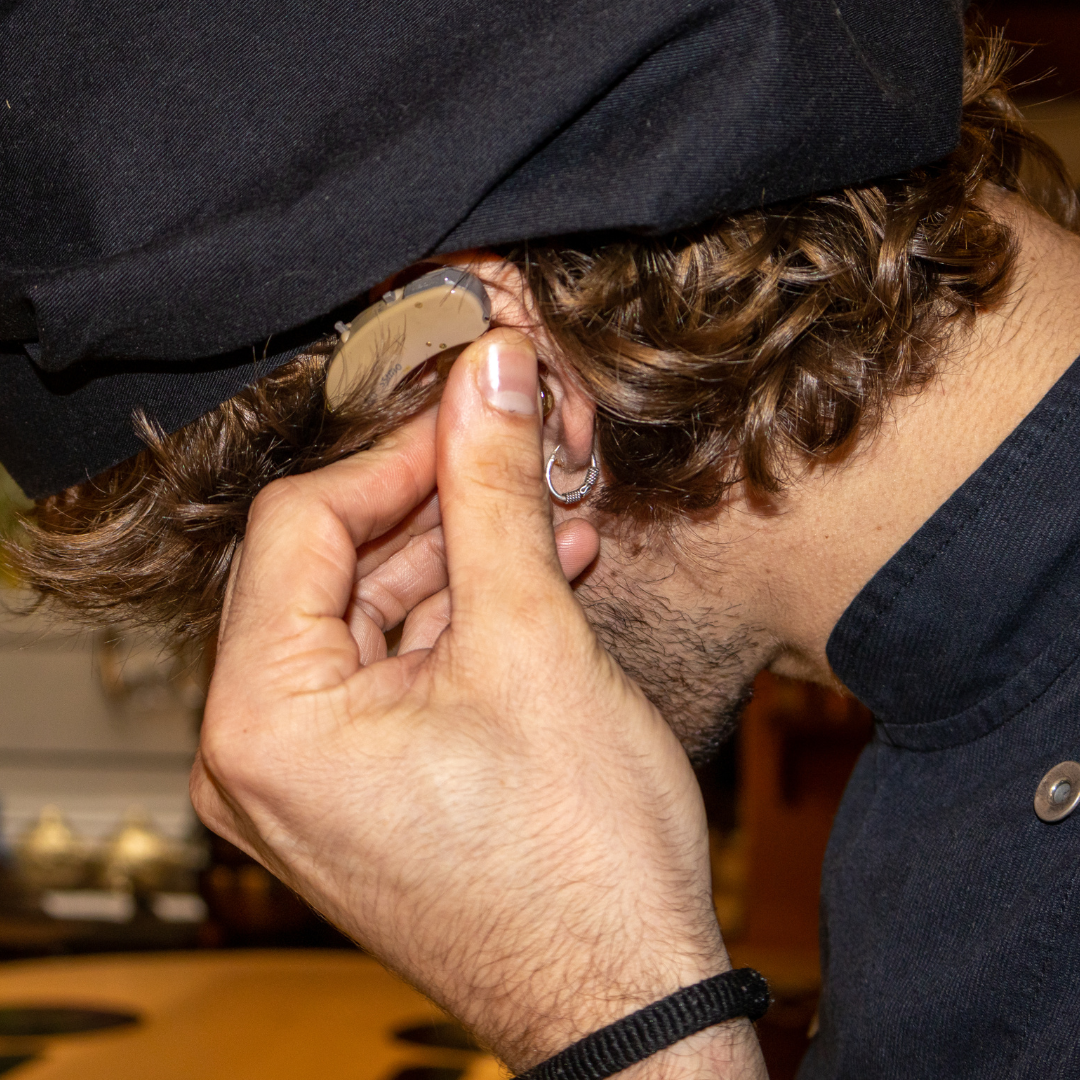
Active restaurant conversations are frequently hard to decipher when surrounding background noise clashes with your hearing. Our practice provides targeted diagnostics to evaluate hearing in quiet atmospheres as well as complex noise environments. When we isolate the root mechanism behind your difficult hearing, we guide you toward customized communication solutions.
Why Can I Hear Normally but Struggle to Listen in a Restaurant?
Low-noise environments yield an advantageous signal-to-noise ratio where primary speech remains significantly louder than background sound. Commercial restaurant spaces present the polar opposite acoustic dynamic. Competing conversations, background music, tableware clatter, and acoustic reflections clash with incoming speech, making auditory processing exceptionally strenuous.
This problem can occur with high-frequency hearing loss, auditory-processing difficulty, or age- and noise-related changes. Dim lighting, physical tiredness, conversational distance, and divided attention exacerbate these listening deficits. It is common to display normal baseline audibility on conventional hearing tests while failing comprehensive speech-in-noise testing. Experiencing speech-recognition struggles in noisy dining venues warrants a formal audiological evaluation regardless of seemingly normal quiet hearing.
The Audiological Process for High-Frequency Hearing Loss
We begin with a history of the situations that cause trouble, along with questions about noise exposure, tinnitus, medications, family history, and changes in either ear.
Through pure-tone audiometry, we determine your faintest auditory perception across low to high pitches utilizing both air and bone conduction testing. A clinical presentation of high-frequency loss produces a downward-sloping audiogram where auditory thresholds worsen significantly at higher frequencies. Additional testing may include tympanometry to assess middle-ear function and word-recognition testing to measure speech understanding.
Because a quiet booth does not recreate a busy dining room, speech-in-noise testing can add valuable information. This diagnostic protocol measures your capacity to understand target words or sentences against progressively louder multi-talker babble. Combined, these clinical findings determine whether your symptoms stem from acoustic audibility, word clarity, central noise filtering, or multifactorial causes.
Adult Auditory Processing Disorders and Speech Perception
An auditory processing disorder affects how the central auditory nervous system interprets sound. Even when the ears detect individual frequencies accurately, the central auditory system may falter at sorting overlapping voices, distinguishing close speech sounds, or processing fast-paced dialogue. We first evaluate peripheral hearing and then determine whether an individualized auditory-processing test battery or referrals to other professionals are appropriate.
Actionable Listening Tips for Noisy Social Settings
Simple situational adjustments enhance the speech signal entering your ears and offer clearer facial cues. Before leaving home, identify quieter dining venues or plan to eat during less crowded service times. Venues with booths, acoustic panels, curtains, carpeting, and other sound-absorbing features may be easier than open rooms filled with hard surfaces.
Upon entering the restaurant:
- Reserve a table located well away from kitchen doors, active bar counters, overhead speakers, and banquet groups.
- Sit with a perimeter wall directly behind you to cut down on ambient noise approaching from the rear.
- Position yourself to directly face companions under bright lighting to enhance facial comprehension.
- Maintain the shortest comfortable physical distance between yourself and your conversation partner.
- Turn your better-hearing ear toward the specific speaker you want to hear most clearly.
- Instruct conversational partners to reword missed phrases instead of repeating the entire sentence verbatim.
- Confirm important details rather than pretending to understand.
- Allow yourself a short listening respite when auditory concentration starts to feel drained.
- Encourage friends to enunciate clearly while maintaining an even, normal conversational tempo.
- Speaking with excessive volume creates acoustic distortion that fails to make words clearer.
The Best Hearing Devices for Overcoming Restaurant Noise
The best technology depends on the cause of the difficulty, the listening environment, and whether hearing loss is present. Advanced hearing aids utilize beamforming directional microphones, adaptive noise reduction, and specialized restaurant programs to elevate voices directly ahead while suppressing ambient chatter. However, users must maintain realistic expectations, as no clinical technology can eliminate every competing background speaker entirely.
Utilizing an external remote microphone can deliver a dramatically superior signal-to-noise ratio. The accessory is worn on the lapel or set near the speaker, streaming their voice directly into compatible hearing aids or wireless audio receivers. By streaming directly, this technology overcomes acoustic falloff from distance and surrounding environmental noise.
Other clinically valuable tools include:
- Omnidirectional table microphones designed for group dining tables
- Telecoil components connecting directly to public hearing-loop systems
- Smartphone live-captioning platforms providing instant speech-to-text visual support
- Smart earbuds offering dedicated speech-in-noise amplification settings
- Sound-meter apps and acoustic dining directories for locating quiet venues
We will help compare available technology, verify device compatibility, and instruct you on utilizing your selected hearing equipment.
Clinical Audiology Care for Hearing in Complex Noise
A thorough audiological evaluation expands the diagnostic scope well past simple quiet listening performance. We analyze the exact social venues, voice registers, and noise environments that cause difficulty to administer tests matching your lifestyle. The diagnostic battery may encompass pure-tone thresholds, acoustic middle-ear evaluations, suprathreshold word recognition, and speech-in-noise measures. Specialized auditory-processing testing can be ordered when patient history and preliminary audiometric findings warrant deeper neural investigation.
Rapidly progressing, asymmetrical, or sudden hearing decline warrants an urgent clinical referral to an ear, nose, and throat physician. Personalized care identifies the source of the difficulty rather than assuming restaurant noise is the only problem.
Contact Us for a Hearing Evaluation Today
If struggling through dinner conversation leaves you mentally exhausted, detached, or constantly guessing, schedule a complete hearing evaluation with our clinic. We can explore ways to help with hearing in noisy environments with hearing-aid adjustments, assistive tools, or rehabilitation options that may fit your needs.
Reach out to our audiology clinic today to schedule an evaluation and begin enjoying clear, effortless conversations.
